

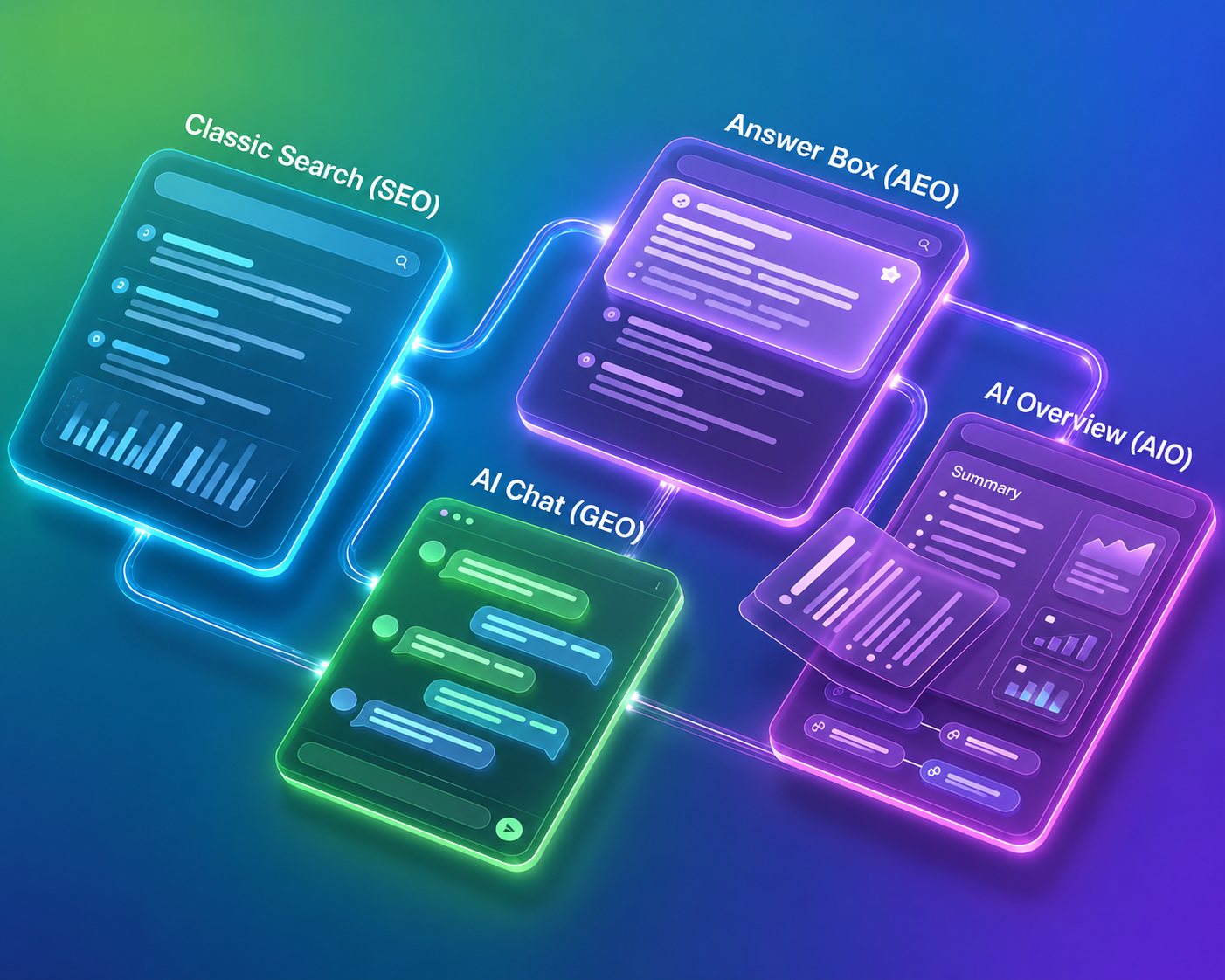
The world of search is evolving faster than ever.
For years, businesses focused almost exclusively on Search Engine Optimization (SEO) to increase rankings and drive organic traffic. Today, however, users are finding information through multiple discovery channels, including Google Search, AI Overviews, ChatGPT, Perplexity, Gemini, voice assistants, and other AI-powered platforms.
As a result, new optimization strategies have emerged. Terms like SEO, AEO, GEO, and AIO are becoming common in marketing discussions, yet many people are unsure what they actually mean and how they differ.
The reality is that these aren’t competing strategies. Instead, they represent different ways of improving visibility across modern search experiences.
Understanding how they work together can help businesses future-proof their digital marketing strategy and stay visible regardless of how users search for information.
A few years ago, a typical customer journey started with a Google search.
Users entered keywords, browsed multiple websites, compared options, and eventually made a decision.
Today, the process is different.
Many users now ask complete questions such as:
Instead of showing only links, AI-powered platforms often generate complete answers.
This shift means businesses need to optimize not only for search engines but also for answer engines and generative AI systems.
That is where SEO, AEO, GEO, and AIO come into play.
Factor | SEO (Search Engine Optimization) | GEO (Generative Engine Optimization) | AEO (Answer Engine Optimization) | AIO (Artificial Intelligence Optimization) |
Primary Goal | Rank higher in search engine results | Get cited and referenced by AI systems | Become the direct answer to user questions | Use AI tools to improve marketing and content performance |
Focus Area | Search engine rankings and organic traffic | AI-generated responses and recommendations | Featured snippets, answer boxes, and voice search | AI-assisted content creation and optimization |
Optimizes For | Google, Bing, and traditional search engines | ChatGPT, Gemini, Claude, Perplexity, and AI Overviews | Google Featured Snippets, voice assistants, and answer engines | AI-powered workflows and content production |
Success Metric | Rankings, clicks, and organic traffic | AI citations, mentions, and AI visibility | Featured snippet placements and direct answers | Productivity, efficiency, and content scalability |
Content Style | Keyword-focused and search intent driven | Authority-driven, factual, and citation-worthy | Clear, concise, and question-based | AI-assisted but human-refined content |
Key Strategy | Technical SEO, content optimization, and backlinks | Entity optimization, expertise, trust, and semantic relevance | FAQ content, structured answers, and schema markup | AI tools for research, writing, optimization, and analysis |
User Journey Stage | Discovery | Recommendation and decision-making | Question answering | Content creation and optimization |
Importance in 2026 | Essential foundation for all digital visibility | Critical for AI search visibility | Important for voice search and featured answers | Important for scaling modern marketing operations |
Example Outcome | Your blog ranks #1 on Google | ChatGPT references your article in its answer | Google displays your content in a featured snippet | AI helps your team create and optimize content faster |
SEO remains the foundation of online visibility.
Search Engine Optimization is the process of improving a website so that search engines like Google and Bing can discover, understand, index, and rank its content.
The primary goal of SEO is to increase organic traffic by appearing higher in traditional search results.
When someone searches for a product, service, or piece of information, SEO helps determine which websites appear on the first page.
Search engines evaluate hundreds of factors when ranking websites.
Some of the most important include:
Content Quality
Search engines prioritize content that provides valuable and relevant information.
Keyword Relevance
Content should align with the terms users search for.
Technical SEO
Fast loading speeds, mobile optimization, crawlability, and proper site architecture remain essential.
Backlinks
Links from authoritative websites help establish trust and credibility.
User Experience
Google increasingly rewards websites that provide a positive user experience.
The Main Goal of SEO
The purpose of SEO is straightforward:
Generate visibility in search results and drive qualified traffic to your website.
Even in the age of AI, SEO remains the foundation upon which all other optimization strategies are built.
Without strong SEO fundamentals, succeeding in AEO, GEO, or AI search becomes significantly more difficult.
Answer Engine Optimization focuses on helping your content become the direct answer to a user’s question.
Instead of simply ranking for a keyword, AEO aims to position content where search engines can instantly extract and display an answer.
You’ve likely seen this when searching Google.
A question appears, and Google displays a featured snippet or answer box before showing traditional search results.
That is AEO in action.
Search behavior has changed dramatically.
Users increasingly ask conversational questions rather than typing short keywords.
Voice assistants like Siri, Alexa, and Google Assistant have accelerated this trend.
People now expect immediate answers.
Instead of searching:
“SEO tips”
They ask:
“What are the best SEO tips for small businesses?”
Answer engines attempt to provide a direct response without requiring multiple clicks.
Successful AEO content typically includes:
Direct Answers
Provide a concise answer immediately after the question.
Question-Based Headings
Use natural language questions as headings.
FAQ Sections
Frequently Asked Questions help search engines identify answer-ready content.
Structured Data
Schema markup helps search engines understand page context.
Clear Formatting
Short paragraphs and logical content structures improve answer extraction.
The Main Goal of AEO
AEO helps your content become the answer rather than simply one of many search results.
Generative Engine Optimization is one of the most important developments in modern digital marketing.
Unlike traditional search engines, generative AI systems create new answers by combining information from multiple sources.
Platforms such as ChatGPT, Gemini, Perplexity, Claude, and Google AI Overviews rely heavily on this process.
GEO focuses on making your content more likely to be cited, referenced, or used by these AI systems when generating answers.
In traditional search, success meant ranking.
In AI search, success often means being mentioned.
If a user asks:
“Which SEO agency is best for AI search optimization?”
An AI system may generate a recommendation using information from several websites.
If your brand appears in that response, GEO is working.
Although both involve answering questions, they serve different purposes.
AEO focuses on providing a direct answer that search engines can extract.
GEO focuses on becoming a trusted source that AI systems reference when creating answers.
Think of it this way:
AEO helps you become the answer.
GEO helps you become the source behind the answer.
Successful GEO requires:
Strong Entity Recognition
AI systems need to clearly understand who you are and what you do.
Authoritative Content
Expert-level content performs better than generic information.
Fact-Based Writing
Specific statistics, examples, and research improve credibility.
Content Structure
AI systems favor content that is easy to extract and interpret.
Cross-Platform Presence
Mentions across websites, social platforms, reviews, and publications strengthen trust signals.
The Main Goal of GEO
Increase the likelihood of being cited, referenced, or recommended by AI-powered search engines.
AIO is often the most misunderstood term.
In modern marketing, AIO generally refers to AI Optimization or optimizing content and workflows for the AI era.
Unlike SEO, AEO, or GEO, which focus on visibility, AIO focuses on how AI improves content creation, research, optimization, and digital marketing processes.
How AIO Is Used
Marketers increasingly use AI tools to:
AI has become an essential productivity tool across nearly every area of digital marketing.
AIO Is Not a Replacement for Human Expertise
One common misconception is that AI can replace strategy.
In reality, successful AIO combines:
The best content today is often created by humans and enhanced with AI rather than created entirely by AI.
The Main Goal of AIO
Use artificial intelligence to improve marketing efficiency, scalability, and content performance.
Although these terms are related, their goals are very different.
SEO focuses on rankings and traffic.
AEO focuses on direct answers.
GEO focuses on AI citations and recommendations.
AIO focuses on using AI tools to improve marketing performance.
A useful way to think about them is as layers of a modern visibility strategy.
SEO creates discoverability.
AEO creates answer visibility.
GEO creates AI visibility.
AIO improves how efficiently you execute all of the above.
The answer depends on your goals.
For most businesses, SEO should remain the starting point.
Without strong technical SEO, quality content, and authority signals, other optimization efforts become less effective.
Once a solid SEO foundation exists:
The strongest digital strategies integrate all four rather than choosing only one.
The future of search will not belong to a single platform.
Users will continue discovering information through:
Businesses that focus only on traditional rankings risk missing significant visibility opportunities.
Success in 2026 and beyond will require a broader approach that combines search optimization, answer optimization, generative AI visibility, and AI-powered content creation.
SEO, GEO, AEO, and AIO are often discussed as separate strategies, but they work best together.
SEO helps people find your content.
AEO helps search engines choose your content as the answer.
GEO helps AI systems reference your content when generating responses.
AIO helps you create, optimize, and scale content more efficiently.
As search continues evolving toward AI-powered experiences, businesses that understand and implement all four approaches will be better positioned to earn visibility, authority, and customers across the entire digital ecosystem.
The future is no longer just about ranking higher.
It’s about being found, trusted, cited, and recommended wherever people search for answers. If you want to appear on the AI Search rank and boost your business, contact us for top-notch local SEO services.
I am Shofiul Alam Tanvir, a top-rated Fiverr, SeoClerk and Upwork freelancer and one of the leading advanced SEO experts in the USA. With over five years of dedicated experience, I specialize in delivering high-impact, data-driven search engine optimization strategies.
©2026. Shofiul Alam Tanvir. All Rights Reserved.
Terms & Conditions
Privacy Policy